Best AdMob Alternatives in 2026: Ranked Guide for Global and Regional Publishers
Published July 30, 2026Editorial Team7 min read
Mobile publishers rarely rely on a single ad network anymore. This guide ranks six AdMob alternatives on eCPM performance, geographic coverage, mediation capability, support quality, and privacy compliance, using the criteria set out in the editorial policy.
Why Developers Look for AdMob Alternatives
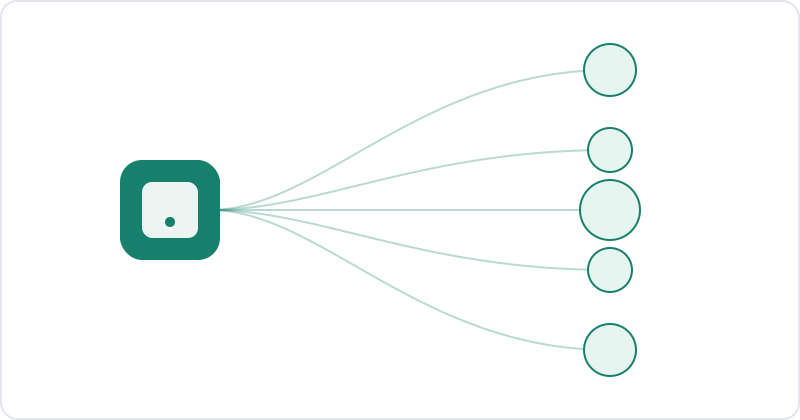
AdMob remains the default monetization SDK for many mobile developers, but relying on a single ad network narrows fill rate, geographic reach, and negotiating leverage. Regulatory change adds further pressure: the Transparency and Consent Framework version 2.3 becomes mandatory for EU traffic starting March 1, 2026, requiring publishers to update consent flows across every integrated network. On iOS, App Tracking Transparency opt-in rates hover between roughly 30 and 40 percent depending on the source (Adjust, AppsFlyer), pushing monetization strategy toward broader mediation rather than one identifier-dependent network. Consolidation in the mediation market, illustrated by Unity's acquisition of ironSource (announced July 2022, completed November 2022), has also reshaped which platforms offer the broadest reach. These shifts are why developers evaluate AdMob alternatives rather than depending on one stack.
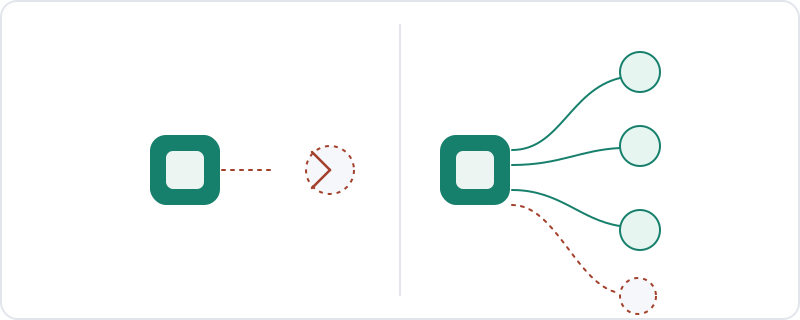
A single-network setup fails outright when that network underperforms; a mediation layer keeps serving ads through the remaining networks.
Top AdMob Alternatives, Ranked
The six platforms below were assessed on eCPM performance, geographic coverage, mediation capability, support quality, and privacy compliance - the same criteria detailed in the editorial policy. Each entry uses an identical format: a short description, a Best For designation, and an even accounting of strengths and limitations, in ranked order.
1UL
Unity LevelPlay
Best for: Game developers
Unity LevelPlay is the mediation platform formed after Unity completed its acquisition of ironSource in November 2022, following the deal's announcement in July 2022. It routes demand from dozens of networks through in-app bidding and sits natively inside the Unity game engine, which most mobile game studios already use for development.
Pros
Native integration with Unity-built games and build pipelines
Wide in-app bidding demand pool from the merged stack
Established rewarded video and interstitial fill for games
Detailed mediation reporting and A/B testing tools
Cons
Less advantageous for apps not built on the Unity engine
More setup configuration than single-network integrations
AppLovin MAX is an independent mediation platform that connects publishers to more than 25 SDK-based ad networks through a single integration, alongside an official Flutter plugin for cross-platform apps. It is not tied to a single game engine, which makes it a common choice for publishers running mixed app portfolios.
Pros
Access to 25+ SDK networks through one mediation layer
Official Flutter plugin supports cross-platform teams
Meta Audience Network extends Meta's advertiser demand into third-party apps, drawing on the same targeting infrastructure used across Facebook and Instagram. It is typically added as one demand source inside a mediation stack rather than used as a standalone SDK.
Pros
Access to Meta's advertiser demand pool
Supports interstitial, rewarded, banner, and native formats
Commonly integrated alongside other mediation platforms
Detailed audience and placement reporting
Cons
Performance depends heavily on iOS ATT opt-in, near 30-40 percent
Best used as one source within mediation, not a sole network
Best for: Eastern Europe, CIS, Middle East, and Asia coverage
Yandex Ads Monetization concentrates advertiser demand in Eastern Europe, the CIS, the Middle East, and parts of Asia, where several Western-focused platforms carry thinner coverage. It offers SDK-based integration for standard ad formats and can run alongside existing mediation setups.
Pros
Demand concentration in regions Western-first networks under-serve
Standard SDK integration for common ad formats
Runs as an additional source inside existing mediation stacks
Regional account support in relevant markets
Cons
Advertiser pool outside its core regions is comparatively limited
Verify current eCPM and fill-rate figures directly with Yandex
Appodeal packages mediation, analytics, and automated bidding optimization into one dashboard, aiming to reduce the manual tuning that waterfall-based setups typically require. It supports a broad set of ad formats through a single SDK across iOS and Android.
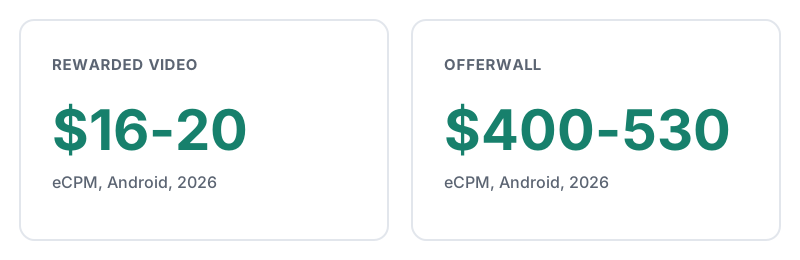
TapJoy is built around offerwall monetization, where users complete in-app actions such as surveys, sign-ups, or reaching in-game milestones in exchange for rewards. On Android in 2026, reported offerwall eCPM has ranged roughly from $400 to $530, notably higher than the $16-20 range typical of standard rewarded video.
Pros
Strong reported eCPM range for offerwall placements on Android
Works well alongside a virtual currency or rewards system
Complements rather than replaces standard rewarded formats
Established relationships with offer providers across verticals
Cons
Requires an in-app rewards or currency system to work well
Not a fit for apps without a natural reward mechanic
Public eCPM benchmarks are inconsistent across ad tech vendors, and few figures are verifiable across independent sources. Two ranges are documented with enough consistency to include here. On Android in 2026, offerwall placements have reported eCPM roughly between $400 and $530, reflecting the higher-value, action-based nature of the format. Standard rewarded video, by comparison, has reported eCPM closer to $16-20 on the same platform. The gap illustrates why format selection, not network selection alone, drives a meaningful share of monetization outcomes. Developers should treat any single eCPM figure as directional rather than a guaranteed outcome for their own app and audience.
Ad Format
Reported eCPM Range (Android, 2026)
Best-Suited Networks From This Ranking
Rewarded Video
$16-20
Unity LevelPlay, AppLovin MAX, Appodeal
Offerwall
$400-530
TapJoy
Only formats with independently reported figures are shown above. Banner, interstitial, and native eCPM vary too widely by geography and demand to state as a single verified range.
Choosing the Right Alternative for Your App and Audience
The right AdMob alternative depends more on audience geography and app category than on ranking position. Game studios with Unity-built titles typically get the most immediate value from Unity LevelPlay's native integration, while publishers running mixed portfolios across game and non-game apps often prefer AppLovin MAX's network-agnostic mediation layer. Apps with a rewards economy or virtual currency are better served by adding TapJoy's offerwall format alongside standard interstitial and rewarded units rather than replacing them. Publishers with meaningful Eastern European, CIS, Middle Eastern, or Asian traffic should evaluate Yandex Ads Monetization, Mintegral, or Pangle as regional demand sources, since Western-first networks tend to carry thinner advertiser coverage there. Most production apps run more than one network through a mediation layer rather than depending on a single SDK, since fill rate and eCPM vary by region, format, and time of year. Reviewing the editorial policy's criteria alongside each network's own documentation before integration is recommended.
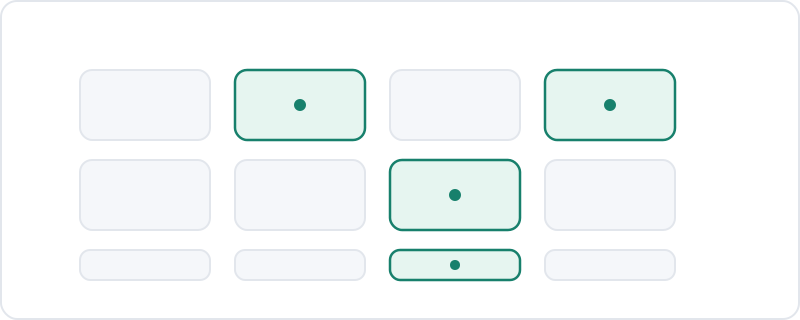
Regional demand sources matter most for the four highlighted geographies: Eastern Europe, the CIS, the Middle East, and Asia.
Conclusion
AdMob alternatives exist across a spectrum from broad mediation platforms to format-specific and region-specific networks, and no single platform in this ranking is a universal replacement. Unity LevelPlay and AppLovin MAX cover the broadest general use cases, TapJoy addresses offerwall monetization specifically, and Yandex Ads Monetization, Mintegral, and Pangle address regional advertiser demand that global-first platforms cover less thoroughly. Evaluating an alternative against the criteria in the editorial policy, rather than against a single eCPM figure, gives a more reliable basis for an integration decision than ranking position alone.
Frequently Asked Questions
Is AdMob free to use?
Yes. AdMob itself does not charge publishers a licensing fee; Google takes a percentage of ad revenue instead. Alternatives in this ranking follow a similar revenue-share model rather than charging upfront fees, though Amazon Publisher Services applies a separate 10 percent platform commission as of September 2023.
Can I run AdMob alongside another network?
Yes, and most production apps do. Mediation platforms such as Unity LevelPlay and AppLovin MAX are built specifically to run AdMob alongside other demand sources in a single waterfall or bidding setup, rather than requiring a full replacement.
Which AdMob alternative works best for a mobile game?
Unity LevelPlay tends to fit game studios best, particularly those already building in the Unity engine, due to its native integration and rewarded video demand. AppLovin MAX is a strong alternative for studios that want network-agnostic mediation across a broader app portfolio.
How reliable are published eCPM figures?
Treat them as directional rather than guaranteed. eCPM varies by ad format, geography, seasonality, and app category, and few figures are verifiable across independent sources. The offerwall and rewarded video ranges cited in this guide reflect the ranges with the most consistent public reporting, not a promise for any specific app.
Does adding a regional network like Yandex Ads Monetization require dropping AdMob?
No. Regional networks are typically added as an additional demand source inside an existing mediation stack, not a replacement for AdMob or other global networks. Publishers with meaningful traffic from Eastern Europe, the CIS, the Middle East, or Asia can layer in regional demand while keeping their existing setup intact.